July 2009

Papeete, Tahiti

We’re on anchor near the marina in Papeete, Tahiti. French Polynesia continues to amaze and impress us at every stop. The Polynesian people are friendly and the islands are spectacular. The traveling is much more challenging than Mexico or Central America, but absolutely worth the extra effort.

The overnight passage from the Tuamotus to Tahiti was quite intense. We had thunder and lightening as bad as any I’ve ever seen in my life – even worse than Central America during the rainy season or the 3 ITCZ crossings we made. We were right in the middle of it for hours as it ever so slowly passed over us. I would see the huge bolts of lightening flash and count seconds to figure out how close it was getting. When it got too close for comfort I just started counting faster, trying to convince myself it really wasn’t only a mile or two off. Rob had put our handheld GPS units and VHF into the stove so we had some way to find our way into Tahiti if we took a hit and lost all of our electronics. The storm finally passed by mid day the next day, and we arrived in Tahiti late on our second day. It was after dark so we pulled in to a bay east of Papeete where there was a wide pass through the reef that was well marked and usable at night.

The next day we moved around into Papeete harbor and Med-moored on a pontoon right in the city. A boat named Imagine was across the dock from us with a new membrane for their watermaker, which Rob spent 5 hours helping install when we arrived. In return for his help, their sister had carried two new laptops down from the states. My brother Tony had helped us find new machines, which we had shipped to his house. He installed all the necessary patches to the operating system and downloaded lots of programs and installed them for us (Thanks TB!). Then with my sister Leslie’s help, they arranged to ship the machines to Kentucky to a person who was flying down to Tahiti the next day. Funny thing was that they were all thinking we were crazy to just ship off two brand new laptops to someone we’ve never heard of before and trust they’ll arrive in Tahiti a day later. In our minds there was no doubt the machines would show up fine – that’s just part of the cruising life. My brother calls it “living by the seat of our Bermuda shorts”; we just call it Karma.

Last night since we were in the city we enjoyed dinner at what they call the Roulottes. They’re a bunch of little vans sitting in a big park near the water with folks making dinner, and they all have little tables and chairs nearby. We had steak with blue cheese and fries for $14, and it was the best value meal in Tahiti. They also make lots of Chinese food. When we were in Lima we found it odd to see Chinese people speaking Spanish after having grown up in the Pacific Northwest where the Chinese speak only Chinese or English. Here the Chinese speak French, which is even more odd for us than Spanish. Another odd event happened our first night out at dinner when two of the local drag queens decided to stop and pose at our table. Don’t know why they chose us, but it was quite a surprise after 6 months away from big cities and big city type people. Apparently the drag queens in this town are quite famous and we shouldn’t have been surprised.

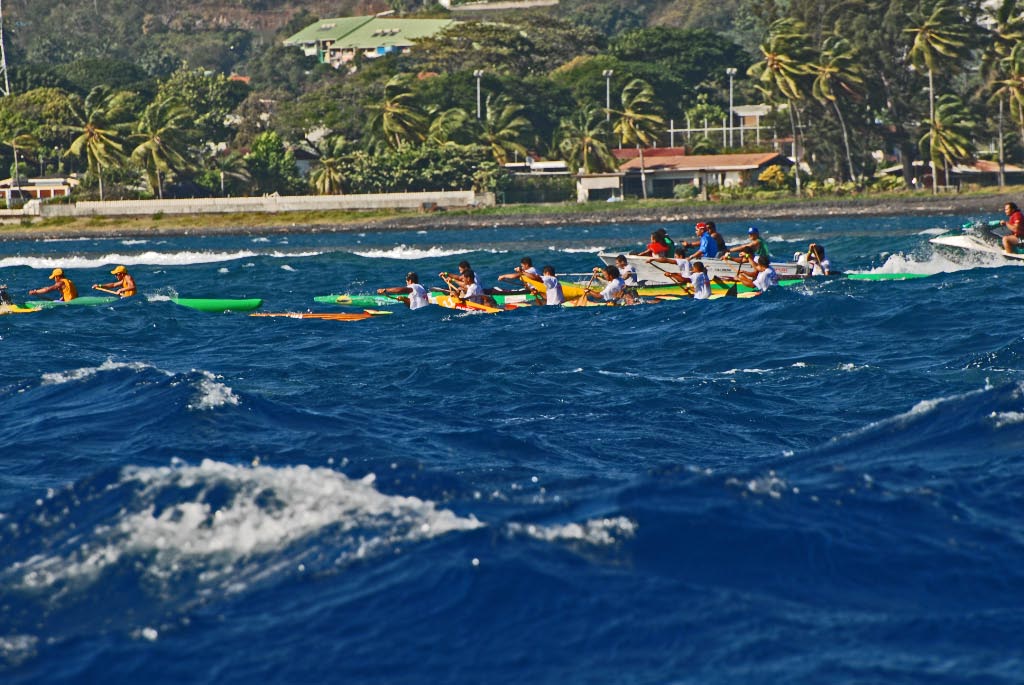
Canoe racing Tahitian styleThe Polynesians are gearing up for their annual winter festival and we’ll likely get to enjoy some dancing and athletic contests. Yesterday there were canoe races with 5 man teams. There were about 40 canoes and they all lined up and started right near our boat at 8 in the morning. About 2:00 in the afternoon they started coming back and they looked absolutely exhausted. We learned this morning that they paddled all the way to Moorea and back – about 12 miles in the open ocean each way. We’ll find out tomorrow what events we can still get tickets for.

We’ll stay in Papeete for a week or so. We’re trying to figure out which way to go at the end of this season, and where there’s some work for two software types. I had hoped to find work in New Zealand or the Marshall Islands, but we need to decide if we’re going north or south. We also need to get a vet out to the boat to draw blood from Maya to ship off to Paris and get a rabies test done. If we end up in New Zealand they’ll need proof that she’s been rabies free for 6 months and only in rabies free countries since then. If we’re working we will undoubtedly be at a dock somewhere and we’ll need to be able to let her off the boat to roam a bit.

Today on Yohelah we’re enjoying Polynesian life and happy to have two new computers……

The anchorage in downtown Papeete is here

12 - Society Islands

Papeete

We’ve been in Papeete for a week now and most of our chores are done. Does it seem like all we do is sail and work on the boat? Well, not entirely.

The windvane took a hit from a big beam on wave on an overnight passage in the Tuamotus and bent. Luckily it bent where it was supposed to, on a tube that’s designed to collapse, saving the other parts of the windvane. So we needed to replace the “collision tube”, which is a 16″ piece of stainless steel tubing that has a lighter wall thickness than the rest of the unit. Sounds like it should be fairly easy, but not so. Rob schlepped around our bent up piece of tubing to every chandlery in Papeete. Finally, when he was almost to the last possible store he was asking at the counter and a Frenchman in line behind him said “I think I have some of that at my boatyard”. Turns out the guy owned a local ferry and had a boatyard where he took Rob. He told his guys to dig in the scrap bin, and sure enough they pulled out a piece that was long enough to cut off two spares for us! He wouldn’t take any money for it, saving us what was about to become an emergency shipment from the states if Rob had completely struck out.

The autopilot also barfed on the way in here, giving us a “drive until failure” message. Rob dug down to the back of the boat where it hooks up to the rudder post and one of the bolts had sheared off, leaving the unit basically hanging in mid air. You definitely could call it a drive unit failure when it’s not even hooked up to the drive unit. Some drilling, pounding, grinding and a little hard work later and the autopilot is behaving again.

Our wind generator also died on the way in here, and that one’s still a mystery. Rob’s written to the manufacturer after checking all the connections and technical electrical stuff, but no answer back yet. And having been a marine electrician in a previous life, Rob definitely understands the electrical things, so hopefully we’ll get some help from the folks who built it.

The biggest project here was to get Maya’s blood tested for rabies, in order to get bio-clearance into New Zealand. We need a blood test that’s more than 6 months old and less than a year old when we arrive in New Zealand. We couldn’t get it done in Central America, but knew we could here, reading from cruiser’s adventures in years past. There is a guy in the anchorage who needed to ask Rob some questions about his watermaker, and during the course of the conversation we found out he had dealt with the same issue to get clearance for his dog here in Papeete. And the good news was there was a French vet who spoke good English on a cruising boat about 200 yards away, who is working with a local clinic. The vet came to our boat the next day and I held Maya tight while he drew a big vial of blood from her right arm (she was such a good kitten). That vial will get shipped to the lab in Australia (one of apparently 3 places in the western world who does this test) on Monday when the vet brings back the sample. That’s been one of our biggest worries for the longest time, thinking we had to deal with a French lab in Paris and the potential language difficulties. Finding an Aussie lab is just the best news ever.

So after we get the blood to Federal Express on Monday we can finish up the last of our provisioning and head north to the rest of the Societies. We really need to get heading toward the Cooks where we can afford to fill up the boat with food again. I know I promised not to whine about the prices anymore, but this is just so crazy. I was at the store looking for fresh chicken and I’m sure I totally gasped out loud when I saw the package of 8 chicken legs for $25.00. Luckily we found the frozen chicken section and can afford to eat a little bit of chicken between here and Rarotonga. I’m just hoping Rob’s fishing gear does well for the rest of the month as we sail between the Society Islands.

heiva

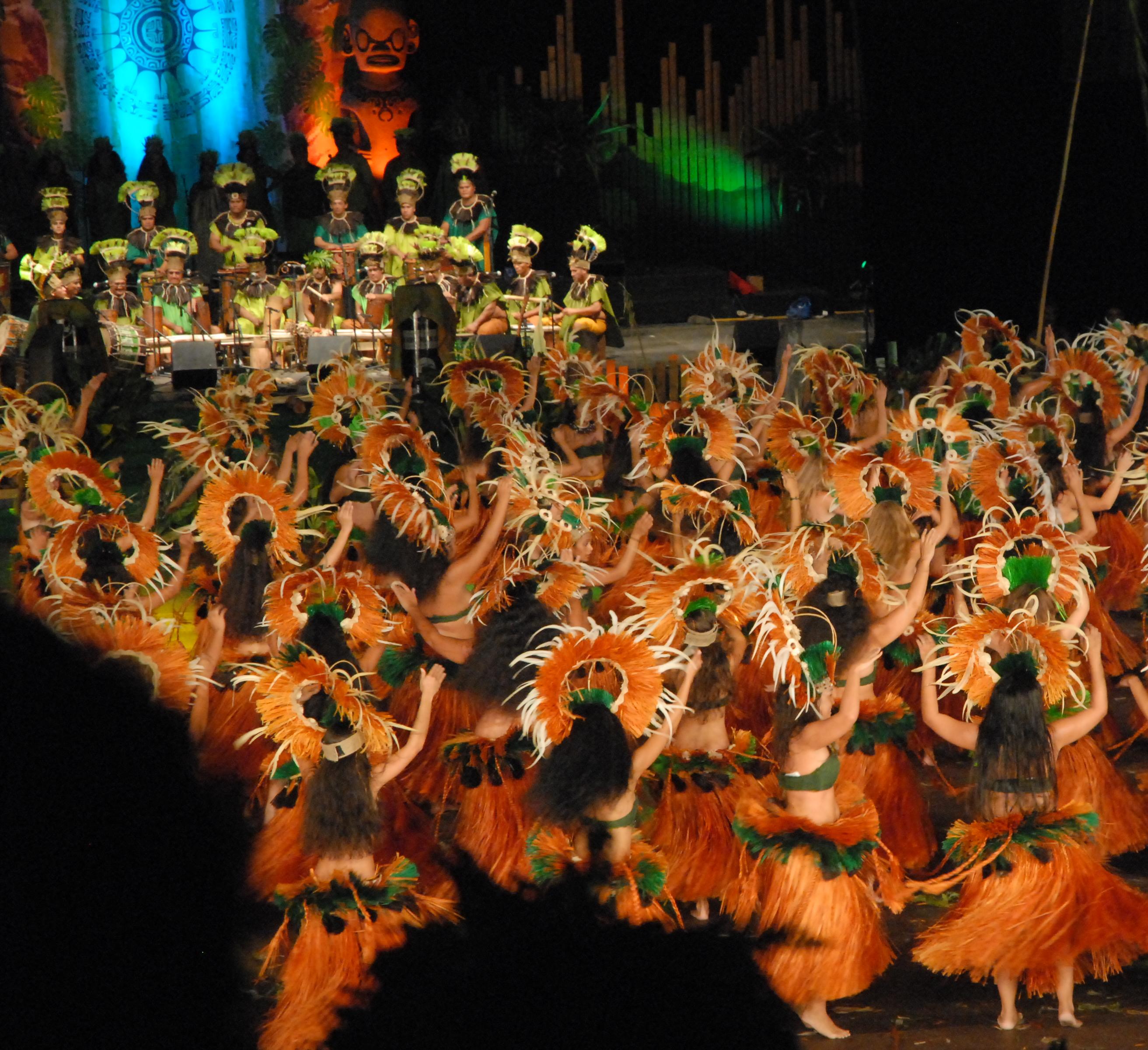
Last night we went with friends to the evening’s performance of the Heiva Festival. It’s an annual dance and song competition, with dance troupes and singing groups performing every night for 8 days, and awards given at the end of the week. All the program info is in French, but what I figured out was that there are two types of dance groups, Heiva and Heiva Nui. The first group we saw has only been performing together for three years and has 100 dancers. They were pretty good. The second group we saw has been together since 1993 and has 160 dancers, and they were awesome. The drums and instruments were mesmerizing, the costumes beautiful, and the dancers and choreography amazing. The only bad part was that no cameras were allowed, so we didn’t get to record any of it. OK, well maybe Rob snuck in a few pictures, but the ushers were constantly scanning the crowd and stopping people who got caught. Each dance troupe performed for an hour, which included multiple costume changes, solo dances, and lots of great traditional music. This is not an event for the tourists, it’s for the locals and they were all out and dressed for a special night on the town. I felt lucky to get to be a part of it.

Today we’re going to scuba dive on a wreck inside the lagoon here in Tahiti with some friends. It’s in about 30′ of water on the outer reef. We haven’t been in the water here yet, but it’s so amazingly clear and we’re looking forward to checking out the wreck. Unfortunately the water temp is only 77 degrees, so we’re glad it’s a relatively shallow dive.

Teresa

The anchorage at Marina Taina in Papeete is here

12 - Society Islands

Goodbye To Warrior – But Only For Now

We first met Robin & Michelle on the boat Warrior in Zihuatanejo when we were so busy with Sailfest in January of 2007. After we crossed the Tehuantepec in February of 2008 and anchored off the coast of El Salvador, Warrior pulled in and dropped a hook behind us a few hours later. Since that time we’ve enjoyed Robin & Michelle’s company off and on as we’ve traveled south, back north again, and further south yet.

They were in the US finishing up work on a research grant when they decided to buy a boat, learn to sail, and take her home to Australia. They found Warrior for sale in California. She had been designed by Brit Chance, a designer of America’s Cup boats and the son of a colleague Robin had worked with early in his career. Warrior is a cold molded wooden boat, 50′ long and built for speed. She was famous in the racing circuit in the US for years, winning Trans Pacs and many other long distance ocean races.

When Warrior left Panama last January they were bound for the Galapagos, Easter Island, Pitcairn, the Gambiers and then back up to the Marquesas. It was a several thousand mile detour south that Robin was determined to make and we wish we had the time to do as well. But Warrior was built to sail to weather and they enjoyed the trip immensely. We didn’t catch up with them again, though, until our stop in Anse Amyot in the Tuamotus.

Robin had started feeling a little off in Panama, and by the time we saw them in the Tuamotus he was feeling pretty bad and had lost a lot of weight. We saw him at dinner twice in Anse and he did a little snorkeling, but they were just waiting for the weather to settle so they could get to Papeete to a doctor. Even with Michelle’s doctorate in language, and French as one of her languages, it became apparent that he needed care at home in his native tongue, so he flew back to Brisbane soon after arriving at Tahiti.

The diagnosis is cancer and he’s home to stay for treatments. In the meantime, Michelle has rounded up crew and is sailing Warrior the remaining 3,700 miles back to Brisbane. That’s a daunting task for any of us to have to take sole responsibility for our little boat without our mate. Michelle wants Warrior home though, to give Robin a special place to hang out while he endures chemo. Warrior and Michelle will take good care of each other on the long voyage home.

Teresa

12 - Society Islands

Moorea

mooreaIt’s about 18 miles from Papeete to Cook’s Bay on Moorea. When all our chores were finally done and we headed across the southerly winds and big south swell were running pretty high, making the anchorage at Papeete uncomfortable and the one at Moorea very inviting. We sailed across and dropped a hook in a sandy spot just inside the pass near Cook’s Bay.

The passes in the Society Islands are much more mellow than the passes in the Tuamotus for a couple of reasons. First, the Societies are still islands and not just empty lagoons that fill up with water, so the amount of water inside the barrier reef is much less and the resulting current is less. Also, the Societies are on what’s called an amphidromic point, where tides are minimal and the water level difference is only 8 inches between high and low tide.

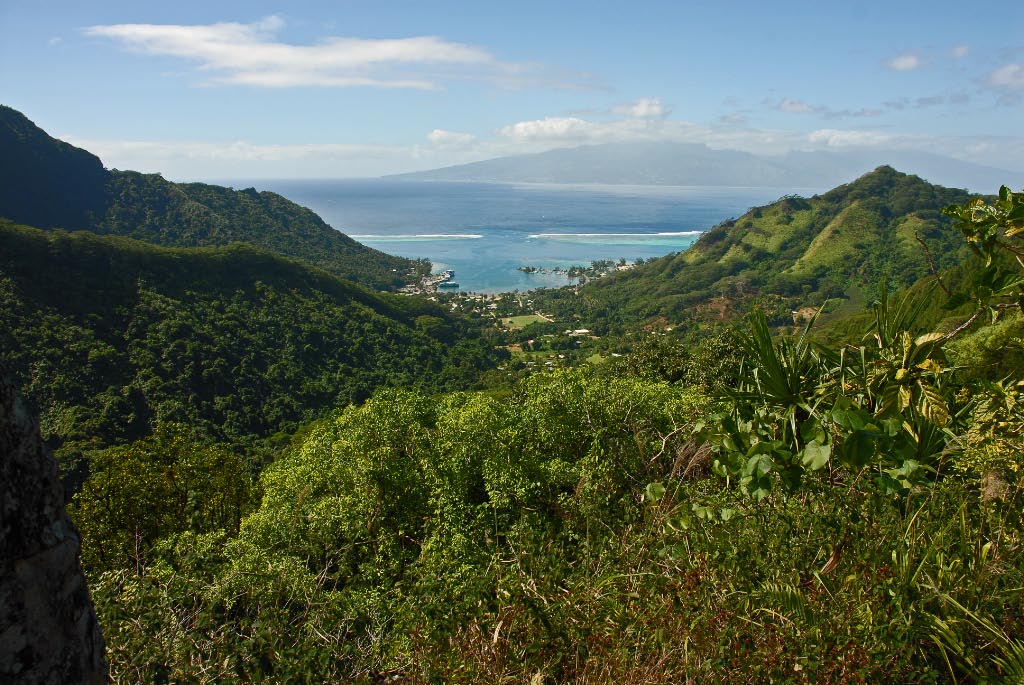
Looking down the valley to Cooks BayThe southerlies ended and we moved into Cook’s Bay and decided to go for what the travel guide described as “an excellent day hike” on a shaded three hour trail. We took a shuttle around the island to the ferry terminal and walked inland on a road that eventually turned into a trail up the mountainside. And up it went. It was definitely the steepest trail we’d hiked in a long time. But in about 90 minutes we were at the top on a ridge with beautiful views where we rested and had lunch. We knew we were a bit slow getting up to the top and guessed we’d have another two hours to get back down. Yeah, not. Somehow we must have missed a right turn. The guidebook only said “on the way down avoid taking the wrong turn at a bamboo grove”. But it didn’t say what the right turn was, and apparently we took the wrong one. After traversing the valley on a lovely trail for another three hours we finally found a road. Unfortunately it went down to the wrong bay. When we got to the road that connects the two bays we stuck out our thumb and the third car had room to take us the 5 miles back to Cook’s Bay. It was a very long day, but we definitely saw lots of Moorea.

The northeasterlies started blowing pretty strong, so we moved around into Opunohu Bay looking for some shelter. We wanted to dive on the outer reef and had to wait for the wind to settle down. Yesterday it was finally calm and we hauled out the dive gear, threw it all into the dink and went out the pass to the buoys the commercial dive boats use. As we descended we were literally swarmed by fish. It’s obvious that the local divemasters feed the fish to amuse their customers. Everything on the dive was looking for a handout, including a huge mooray eel who came half out of his hole looking hopeful, and a 4′ black tipped reef shark who swam with us the entire 40 minutes we were down (I named him Sammy). There were two enormous turtles snacking on the reef that weren’t bothered by us and we swam with them for about 10 minutes. I’ve never been 5′ from a turtle before and could have swam up and grabbed ahold and gone for a ride, but I really didn’t want to bother them. Sadly though, the coral was nearly all dead. It would have been an incredible dive if the coral had been alive, and it didn’t look like it had been dead for long like the reefs in the Caribbean, but there were scarcely few places where it was healthy. We were extremely happy we had done the dives in the Tuamotus and seen coral reefs still spectacularly healthy because apparently here they’re not.

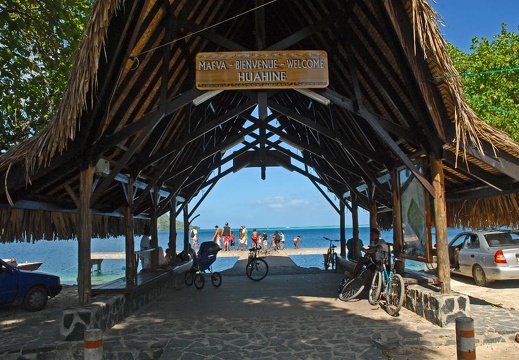
Last night we were going to leave for the northern Societies, which are just far enough northwest that we have to travel overnight in order to arrive during daylight. But a front was passing through and it was cloudy and rainy in the afternoon when we should have been getting ready to leave, which did not inspire us to get ready and go. The winds were forecast to be light overnight and the thought of motoring all night in the rain didn’t have much appeal. Of course as soon as it got dark the skies cleared and the wind started howling. We ended up with 25 knots of wind for most of the night in the anchorage, which was really noisy and unpleasant given that we were anchored in a narrow slot between two reefs (definitely between and rock and a hard place). This morning the sun is back out and the winds seem to have settled back into a southeasterly, which is the normal direction for the trades. So we moved back into Cook’s Bay so I can upload some pictures to the website. Tonight for sure we’ll hoist sail at sunset and make our overnight passage to Huahine.

I’ve been studying the weather down here for a long time and am finally starting to understand a little bit of what’s going on. There are definitely lots of factors down here that affect the weather differently than in the northern hemisphere; the primary one being that there are no huge continents. The forecasters here are now nearly officially calling this an El Nino year, which for us is ok. What it means is the trades will be lighter than normal, which we’ve already experienced all the way from the Galapagos. It also means the south pacific convergence zone (the area where the southeast trades bump into the equatorial easterlies) will be further north than usual. That makes our choice to visit the southern Cook Islands a good one, but might make a visit to Niue and Samoa difficult and unpleasant.

So far we’ve enjoyed the Societies and look forward to our last 17 days in French Polynesia before our visas expire. I was hopeful that since we’ve got our international zarpe already, maybe we could cheat a little bit in Bora Bora and not quite get underway on time. But this morning the local Gendarme boat came by and four guys came aboard and checked all our papers and passports. Guess we’ll have to play by the rules afterall.

Teresa

Cook’s Bay in Moorea is here

12 - Society Islands

I’m Still Waiting

When we were in Playa Coco during Papagayo season last winter we met a guy who was singlehanding a Union 36 from the east coast of the US around and up to Alaska, traveling upwind most of the time. He was convinced that there was absolutely no such thing as a “good passage”, and that we just managed to forget the horrid stuff and remember the not so terrible parts. At the time we strongly disagreed.

We’ve met plenty of people who hate passages but many more who enjoy them. Most folks just endure them, I think. Rob & I were strongly in the camp of really enjoying most of our passages. Then we got to the South Pacific. What was it I said yesterday about finally starting to understand the weather here? Apparently that was a mistake!

Looking closer this afternoon at the weather charts I can see the front that we drove out into last night. It was a beautiful day in Moorea and I thought the front had passed through well enough to have a decent passage. Nope. The seas were a mess and the boat rolled and pitched violently all night. Things were flying from every corner of the boat, and we’re really good at keeping things put up. The boat has never been this much of a mess.

When we arrived this morning a squall was passing through and it was raining so hard I couldn’t see to drive into the pass and get an anchor down. So we turned around and waited until the squall passed and the rain slowed down enough to see. When we came back into the anchorage another squall moved on top of us and we were trying to anchor in 75 feet of water with 35 knots of wind. Not an easy task, and we got a hook down but ended up in the middle of the channel. After that squall passed by we up anchored, came in closer to shore and settled into a lovely spot in 20 feet of water just off the beach.

It was so rough we didn’t eat any dinner last night, which wouldn’t have mattered to me anyway because I was actually seasick enough to throw up before I managed to get a dose of Stugeron into me. So needless to say our first order of business this morning was breakfast, followed by a nap. When the boat is rolling violently side to side every 8-10 seconds there is little sleep happening on your off watch.

I do remind myself that even though the passages suck down here, I am still afterall in the South Pacific on my own little boat, living a life I do love. But truly, I am still waiting for a decent South Pacific passage.

Teresa

Huahine is here

12 - Society Islands

A Quick Stop in Raiatea

Something you never get to do at home is hop in the water with your snorkel gear to check your anchor when it’s being fussy about setting. That’s just what I did yesterday after the third time we tried to get it to set and still weren’t sure it really was. We could see the bottom as we dropped and it looked like there was just rock over hardpan, and sure enough I think we were right. The anchor was wrapped in 90 degree turns around two bommies and just laying on it’s side on top of the rocks. The cruising guides called it a “fair weather anchorage”, which I guess means you don’t need more than the weight of your anchor and chain.

We’re in Raiatea where there’s a wreck inside the lagoon that we stopped to dive on. We took the dink over to the dive site after we anchored and found the visibility in the lagoon really crappy. Even after I got in the water and snorkeled down as deep as I could, I couldn’t see any evidence of the 200′ ship in 80′ of water. There seems to be some sort of a bloom in the water, maybe even jellyfish. 100′ visibility in the South Pacific isn’t unusual, and I couldn’t see probably more than 15′.

About 3:00 the wind started picking up from the southeast and the waves started building in the lagoon. I quickly checked the weather forecast and discovered that nope, this wouldn’t be a “fair weather” night, so we opted out of the pretty little anchorage in front of the motu. Not surprisingly, when we got ready to up anchor we realized all the other cruising boats but one had left and there were only charter boats remaining.

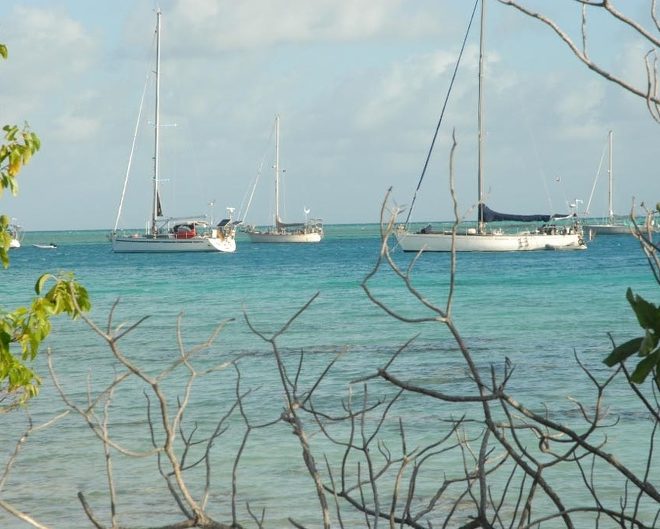
A huge lagoon inside the reef with lots of room for sailingFrom what we’ve seen so far, the Society Islands seem to be the best of the Marquesas and Tuamotus. The islands are beautiful towering green mountains, with high peaks, sharp cliffs and steep faces, which are surrounded by coral reefs with a lagoon between the reef and the shoreline that’s generally deep enough to navigate through. We have beautiful bays to anchor in with no ocean swell. Of course you lose the isolation of the Tuamotus and Marquesas, so if it’s peace and quiet you’re looking for you don’t come here for that. But if it’s a lovely anchorage that’s not rolly with stunning islands behind you, right here is the place to be.

Surprisingly to us it gets really cold here at night. We didn’t notice this in Tahiti, but as soon as we got to Moorea we found very chilly nights and mornings. Chilly, of course, is truly a relative term. But let’s just say there are no fans running at night and the hatches are closed for the first time in years. Maya goes out to play usually about 3 or 4 in the morning, and when she came in this morning (in the front portlight directly onto our bed) she was soaking wet from the heavy dew. She’s the only cat I’ve ever had who just doesn’t care that she’s wet, and plays in the sink with the faucet running. Needless to say, with as hot as it gets during the day, we’re enjoying the refreshingly cool nights.

I was sitting in the cockpit enjoying the cool evening air two nights ago when Maya found a lone wasp out late to chase. My hair was unpinned and hanging down, and she chased it right into my hair. Truly a big hair nightmare to have a wasp tangled up in it. Neither of us was very happy, both before he stung me in the face and after.

Today we’ll head over to Bora Bora and stay there until our visas run out. We’ve got about 10 days left and want to get rested up and enjoy Bora Bora for a while before we have to leave. It’s called “the most beautiful island in the South Pacific”, so we have high expectations after what we’ve seen so far. There’s a dive site called “manta dance” inside the lagoon where the manta rays come play, and we’re looking forward to that. I haven’t seen any manta rays up close yet and want a chance to add that to the list of amazing things we’ve enjoyed here in French Polynesia.

Teresa

Raiatea is here

12 - Society Islands