November 2009

Back in the ITCZ Again

Miles traveled day 6: 85
Miles traveled day 7: 115
Miles traveled total: 781
Miles to Majuro: 1,064

Squalls AheadWell the weather certainly has been doing its job of disrupting our routine and keeping us busy. We’re right smack in the middle of the ITCZ, which means light winds and thunder squalls. And this time the squalls are gigantic. I don’t remember them being this big before, but I suppose they were. They seem to be really active first thing in the morning – maybe from the sun coming up and heating up the huge clouds? Don’t know for sure, but what I do know is that I spent an hour this morning driving east to keep from going thought the middle of something that looked like a mushroom cloud from a nuclear bomb. Rob’s outside right now figuring out what to do with the next one that’s headed our way.

What the squalls do that’s good, though, is give us some wind. The forecasts all say we should have 2-3 knots today and we’ve got 8-10 right now. I never knew this boat would sail so well in 8 knots of wind, but as long as it’s on the beam or forward we scoot along pretty nice. Last night we had 8 knots all night with flat seas and it was a really nice ride. We’re not breaking any mileage records, but in 7 days out we’ve only motored 100 miles and burned less than 20 gallons of fuel so far. Our hope is to be in Majuro by Friday the 13th, but we’re just too far out right now to make any predictions.

We’re getting lots of updates from friends on the Tonga to New Zealand passage right now and it’s sad to not be with them. Our friends John & Nicole on Gannet are on the last leg of their 9 year journey. They bought their boat in England when they worked in Saudi Arabia and have sailed from England to northern New Zealand, where they own a home that they’ve never lived in. They’re both happy and sad to put Gannet on a mooring and see what life on land is like again after nearly a decade at sea.

Rob & I are ready for a little rest time as well. When we pick up the buoy in Majuro it will have been almost exactly a year and 11,500 miles since we left Ecuador. Phew, I get tired just thinking about it.

Teresa

17 - Marshalls Passage

Forecast Schmorecast

Miles traveled day 8: 98
Miles traveled day 9: 110
Miles traveled total: 989
Miles to Majuro: 865

For the last several days the forecast has been for very light winds. We’ve been sailing along quite nicely, and even mostly in the direction we want to go, with 8-10 knots on the beam. Now the forecast is for the winds to pick up and it’s turned behind us and lightened up a bit and we’re struggling to keep the boat moving. The spinnaker’s up but it keeps filling and collapsing as the swell moves under us and causes us to roll.

Yesterday the skies were clear and blue with no clouds to be seen. Today I think we’re also going to be spared the squally conditions. It’s pretty easy to tell that we’ve sailed up close to the equator again – I’m sitting here at the chart table dripping away with only my fingers moving. We’re at 4 degrees south and the equatorial sun is blazingly hot. When we’re both in the cockpit at the same time we crowd into any space with shade. But we’re well over half way there and that’s always a happy milestone.

Right now if we can maintain 4 knots we’ll be in Majuro by Friday the 13th. If we don’t make it by Friday we either have to slow down and wait until Monday or pay a huge overtime fee for weekend check-in by the authorities. Majuro is a small atoll, with no place to stop and hide unnoticed if we arrive on the weekend. As I look at the GPS right at this moment we’re making 3.3 knots, probably only 2.9 to the good because we’re steering high to try and keep the chute full. The forecast says we’ll have 15-20 knots of wind in 4 days. Right.

Teresa

17 - Marshalls Passage

Tonga to the Marshall Islands, first week or so

This has been a slow passage so far. On most of our South Pacific passages we were wishing for a little less wind at times. We could use a little more. We’ve only had one day above our normal average miles while on passage, and that was the first day out of Tonga. Our slowest so far was an 85 mile day that would have been 65 miles if not for the 9 hours of motor assisted sailing that increased our speed by a couple of knots.

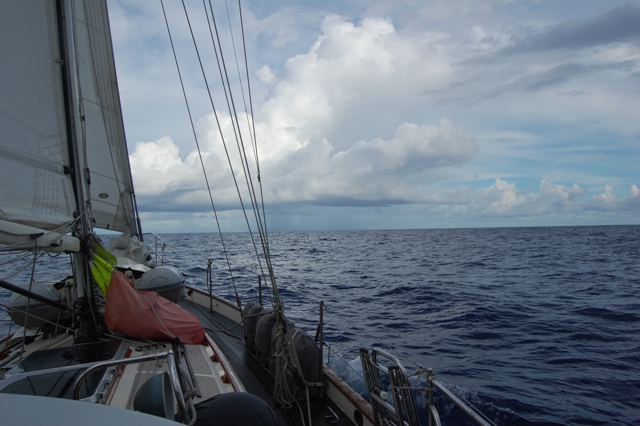
The most fascinating thing on this passage has been the thunderstorms. The equatorial sun is merciless and evaporates a lot of water into the air. Around midnight the air has cooled enough that the clouds start to grow. By 3 am it has cooled more and the growth is rapid, almost cartoon like. Thunderstorms sprout up all around us, towering thousands of feet in the air and producing rain that looks like a black, impenetrable curtain across the water. With a full moon, it’s been hard to miss even in the middle of the night. While our radar cannot see clouds, it can show the rain, which is how we track thunderstorm locations. A couple of nights ago we had just dodged one thunderstorm when another appeared off our starboard side, on a converging course. With one thunderstorm off our beam, another 5 miles behind us and another 4 miles ahead, I decided to veer to the right and duck behind the one closing, guessing I had enough room to cross in front of the next. Burning precious diesel. I approached the middle thunderstorm, staring up at the towering clouds. The radar showed the curtain of rain at a mile off the port beam as we passed through the black clouds above us. We popped through to the other side, and continued off course until the next thunderstorm looked like it was safely past. Twenty minutes later the clouds and rain filled in between the three thunderheads, producing a black mass of rain 12 miles long and 2 miles wide. It took two hours and, combined with Teresa’s c-shaped dodging of another thunderstorm earlier, contributed to 15 miles of sideways non-progress that day.

The opposite happens during the day. The afternoon before, we had another ugly thunderstorm on a converging course form the east. I first saw it on radar at 24 miles, and watched as it grew closer and closer. At 5 miles (two hours later) it was still closing but looked like it was raining itself out. At three miles, the rain stopped, and fifteen minutes later the cloud literally disappeared into thin air (actually it disappeared into thick, muggy air) as the relentless sun evaporated the remaining moisture It truly looked surreal.

So why do we dodge them? The bigger ones have their own wind systems that are independent of the prevailing wind. Entering a squall or thunderstorm can produce violent and erratic winds of 30, 40, 50 knots or more. I have to say the winds in these don’t appear to be too bad, somewhere in the 20 knot range. Another fear is water spouts. We’ve not seen any on this passage but on our passage across the equator and into the Galapagos we passed a squall 3 miles off our beam that had three waterspouts. They didn’t get close, neither did we. Additionally, the rain is amazing. It rains so hard it flattens the wind waves, leaving a glossy swell behind. The rain makes a white mist as it hits, producing a solid white foam at the surface, looking for all the world like snow. If we can, we prefer to avoid them. When it takes us to far afield, we go through them. It’s like beating your head against a brick wall, it always feels so good to reach clear air on the other side.

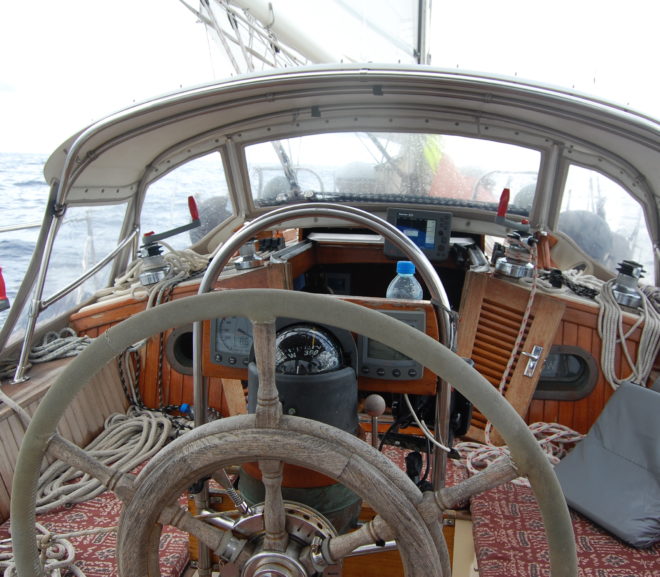
We’re sailing wing-on-wing with the spinnaker pole on the jib. We can actually fly this combination easily from dead down wind to wind 110 degrees off the bow on the starboard side. Any further forward and the danger of backwinding the jib increases. If the forecast holds we should have another day of this before we take down the pole and shift the jib to the port side for a nice beam reach for a day or two. If the forecast holds, we’ll see.

There is a huge fleet of cruising boats heading for New Zealand right now. It was hard to turn north as the majority of our friends turned south toward New Zealand. After a big end-of-season party in Nuku’Alofa on the thirtieth of October many boats headed south. Unfortunately, a huge high pressure system has formed between New Zealand and Tonga so there is no wind to sail. Since most cruising boats have a motoring range of between 300-600 miles, many boats have stopped at Minerva Reef, a popular ‘no-dry-land’ anchorage 800 miles from New Zealand. We just received an email from friends reporting over 20 boats anchored in Minerva, and the number is growing. The high pressure system is building stronger, which may be unfortunate. The low pressure systems still keep coming off the southern ocean and are starting to stack up. This will produce a squash zone between systems of very high winds. It will be interesting to see what weather develops around Minerva Reef when this high moves on, and what progressions of lows are produced. Personally, I’d rather be here.

Today on Yohelah we’re sweltering in the Equatorial sun, as opposed to the reports of foulies and fleeces from the majority of the boats that left Vava’u with us but heading south and now approaching New Zealand.

Rob
The boat is here

17 - Marshalls Passage

The Cost Of Wind

Miles traveled day 10: 107
Miles traveled day 11: 128
Miles traveled day 12: 121
Miles traveled total: 1,345
Miles to Majuro: 529

The notion of sailing around the world by harnessing the power of the wind for free has such a romantic ring to it. Sitting in port reading all those glossy cruising magazines always makes it sound so easy. But in the end, as we all know, there’s no free lunch and there is no free wind. After I scoffed at the forecast earlier in the week it did prove me wrong and the wind did pipe up to 20 knots and higher. Then we were reminded of the difference between the calm flat seas of a light wind passage and the boisterous lumpy seas of a big wind passage. The unfortunate fact is that the increase in speed is not linear to the increase in wind velocity, as the boat has to pound through the rough seas generated by the big winds.

The biggest benefits are fewer nights on passage with an earlier arrival in port, and not having to listen to the sails slat back and forth. The drawbacks include bruised limbs from banging into doors and walls and cupboards in the big wind and seas. The meals definitely aren’t as good when we’re pounding, but gourmet eating isn’t a requirement for getting the boat from one port to another (ok, I would never call what we eat onboard as gourmet anyway). As a last resort I’ve still got 3 packets of meat sauce in the freezer and lots of stuffed pasta that Dream Time offloaded in Vava’u because it would get confiscated by the New Zealand authorities anyway.

As for the fleet headed south now, Hello World wrote today that most have left Minerva Reef to sail the last leg to New Zealand. There were about 30 boats in Minerva, which basically is just a hole in the ocean 3.5 miles wide with no visible land but a good sandy bottom. The high that had shut down the wind between there and New Zealand is being pushed away and there is going to be a pretty good breeze for the next few days.

Our forecast is to have a little lighter winds for the remainder of our passage, but not as light as early on. Hopefully the seas will flatten soon and the ride will smooth out. We’re hoping for a Wednesday landfall (atollfall) in Majuro. For now we’re happy to pay the price of comfort versus speed to get some good wind and be done with this passage.

Teresa
The boat is here.

17 - Marshalls Passage

Like A Horse To The Barn

Miles traveled day 13: 130
Miles traveled day 14: 114
Miles traveled day 15: 119
Miles traveled total: 1,708
Miles to Majuro (as of 11/10): 196

Since the last update we’ve had some marvelous days and nights sailing, and we’ve had some real stinkers. Last night just before dinner I tried to outrun what we thought was just another growing squall. We managed to get to an edge of it as it began to pass, but then it started growing and growing. Pretty soon the radar was showing us completely surrounded by rain for 8 miles all around us. The wind was piping up and gusting to 35 and the rain was just pouring down. And it poured for hours. For the first time in 3 years of cruising we chose to just batten down the hatches and wait it out inside. When Rob woke me at 11:00 the rain had stopped, but there was another cell forming just upwind of us. Rats, it was another monster squall, this time with 40 knots of wind and driving rain. But it only lasted a couple of hours and when I woke Rob at 2:00 I was happy to report that the rain was done for the moment.

Last night on the PacSea net I was told by the net controller that he had been looking at a weather chart for our area, and his conclusion agreed with our Buoyweather passage forecast that there would be no wind at all here today. We’ve got plenty of fuel left and can easily motor the rest of the way in. Imagine my surprise when the wind piped up at sunrise and I rolled out the jib and shut off the motor. Pretty soon it had built to 20 knots on our beam and we were screaming along at 7 knots. That would be all well and good, but we get to the edge of Majuro atoll in 60 miles and don’t want it to be in the middle of the night. So I’ve rolled in the jib and slowed us to 4 knots, hoping for a sunrise approach to the atoll. It’s had to try and go slow in good wind after 16 days of trying to go fast in light winds. But we really don’t like being anywhere near land in the middle of the night, even though we have paper charts and radar and chart plotters and multiple gps units all telling us exactly where we are and where land is.


We should be on a buoy and checked in by noon tomorrow. First order of business in town after checking in is buying cat litter. Poor Maya is literally scraping the bottom of the box. Little did we expect to not find any after we left Bora Bora, since it had been everywhere before there. We actually were planning a rendezvous with friends in Pago Pago to make a stealth stop on the way to Majuro and get some. Since the tsunami the port captain has increased the check-in fees to $150 for cruising boats, so it didn’t make sense to stop just for shopping at that price. But I had not received email confirmation that we could buy litter in Majuro, so I was getting pretty concerned. Our friends on Carina were arranging for us to either sneak in on Sunday and get to the store, or meet us in the harbor with cat litter in hand. Finally I heard back from the SSCA (Seven Seas Cruising Association) host at Majuro that we could buy three different kinds of cat litter there. Good news for all aboard, that’s for sure.

So now we’re plugging along at 4 knots, keeping the reigns in tight because after 16 days at sea and with 20 knots of wind Yohelah wants to sail to the buoy like a horse returning to the barn.

Teresa

17 - Marshalls Passage

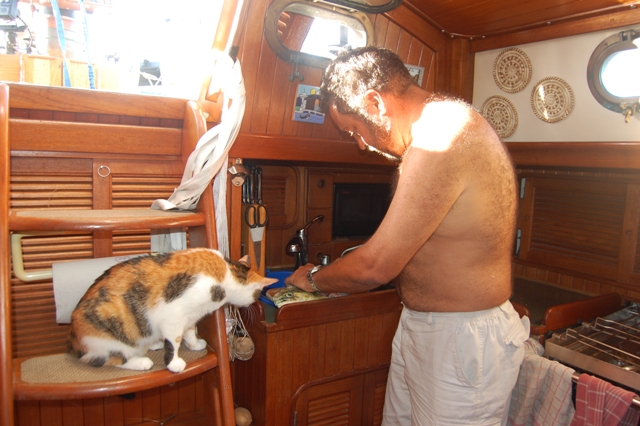
Maya the fishercat

The first part of this passage was a little disappointing from a fishing perspective, especially for boat cat Maya. We trolled and caught nothing. As we left atolls and sea mounts behind the odds of finding fish in the middle of no where dwindled. Maya has been directing fishing operations lately, partly to alleviate boredom and partly to ensure we are doing everything we can to catch fish.

We lost the first Mahi Mahi we hooked on one of our green and yellow ‘octopus’ squids while bringing it aboard. Maya was most disgusted. Later that same afternoon we had another bungee explosion as something way too big snatched another of our green and yellow octopi, breaking the 100 pound test SS leader. I was sad to lose a stainless hook and some plastic beads, both rare in the stores of the South Pacific – I have plenty more squids (Yamamshita OCTOPUS size#55 in green/yellow seem to be working very well for us.) Fortunately, the next day we landed two Mahi Mahi, followed by one more yesterday. This has given us another successful lure, a blue and white skirt attached to a faux-pearl head with rhinestone eyes I found in a store in the Marquesas. Maya is ecstatic, glad we finally managed to overcome our clumsiness and pull some fish onboard. I’m her best buddy when I’m cleaning a fish, she will eat sashimi until she gets sick.

Perhaps hubris at our current fishing success, we have deployed the 8″ cedar plug, which was deadly against the larger Mahi Mahi in Central America. It would be nice to land enough meat to fill the freezer before stopping tomorrow.

MayaFishNot sure if she is sensing the end of the passage or if all the fresh Mahi Mahi has picked up her spirits, but Maya seems a bit less bored than just a few days ago. For an outdoor night cat passages are an endurance for her. She still doesn’t like all the noises the boat makes as it plods along in it many different configurations. A pile of pillows topped with a blanket gives her a quiet place to ‘hide’, some days she never comes out. All will be back to normal in another day as we close in on Majuro. All three of us will be happy to have our slowest passage behind us.

Rob

17 - Marshalls Passage

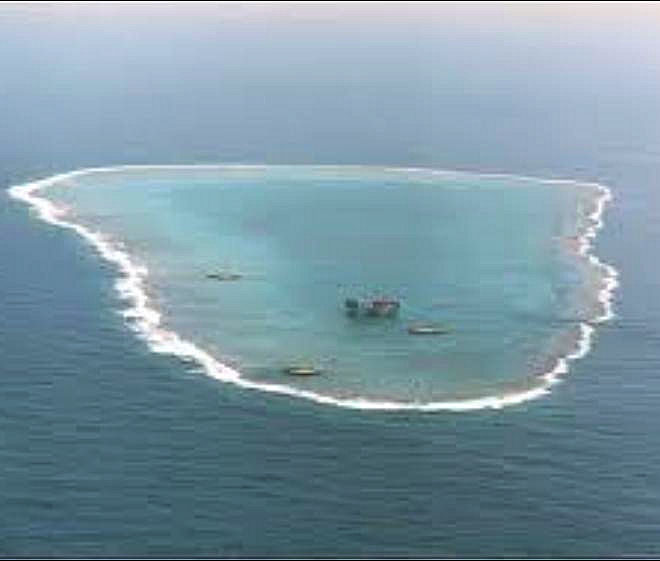
Majuro Atoll

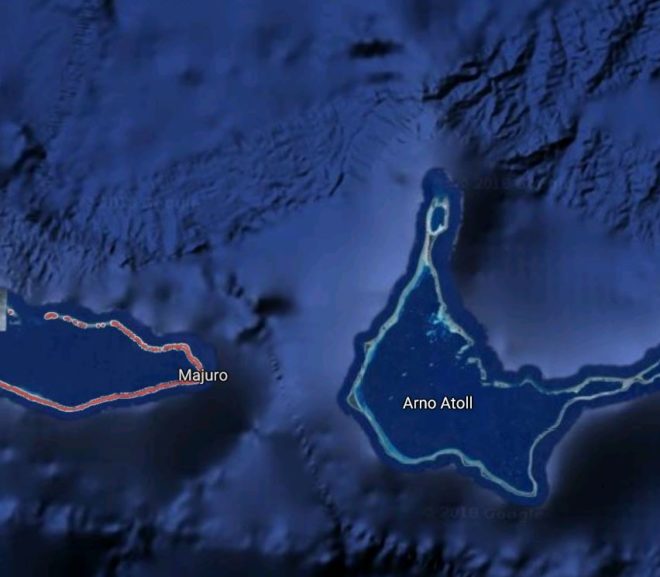
Our sunrise approach to the Marshall Islands happened just as planned. When I got up for my 5:00 am watch I could see Majuro Atoll and it’s neighbor Arno Atoll on the radar, and as the sun rose I rolled out the jib and we sailed between them. This is a huge lagoon and the pass is in the middle, about 2 hours from where the town is on the east side. As we motored in one of the yachties helped us get settled on a buoy where we’ve been ever since. It began raining off and on about 24 hours before we arrived and has continued pretty steadily since then. We kept hearing from the other cruisers here that the rain was unusual, but it didn’t seem to want to stop. Finally we learned that the rainy season doesn’t officially end until December, so we feel a little better about the constant drizzle. Almost feels like home, except the heat that goes with it.

Yesterday it did clear up long enough for it to get seriously hot. We put up the sun awning and pulled down the jib. The outer layer of sunbrella along the foot of the jib had come loose on this last passage and obviously needed some stitching. With the jib down it was apparent that all the thread that had been exposed full time to UV was rotten. The fabric right at the top near the head was also disintegrating and needed repairs. We moved the jib down into the salon to avoid the heat of the sun and I re-stitched the entire length of the foot and repaired the leech of the sail, along with the corner patches. Along the luff where it hoists into the slot in the roller furling I repaired some wear spots and reinforced the head. I soon learned that wrestling around 40 pounds of sailcloth inside an 85 degree boat will make you work up a big sweat in a big hurry.

After dinner we pulled down the big awning, which was a very wise choice because at about 4:30 this morning the wind started howling as the skies opened up and poured. Unfortunately neither of us was in the mood to go outside at that hour to open the deck fills and let the water fill the tanks, so it was all lost over the side and into the lagoon instead. This morning on the local cruiser’s net we heard that the weather is going to be basically clouds and rain and crappy all week. Hopefully we’ll have a calm period to get this sail out of the salon and back up into the furling before I leave on Wednesday.

It didn’t take long after we arrived to see most of what is in town. The atoll has one main road, and in most places is only two or three blocks wide between the lagoon and the ocean. Taxis drive up and down the road all day and you just stand alongside and hold out fingers to indicate how many of you need a ride. Nobody asks you where you’re going because there’s only one direction to go (hopefully you were standing on the correct side of the road), and you just tell the driver where to stop. It used to be $1.00 to go anywhere on the atoll, but according to an article in the local paper, some Chinese drivers have started a price war and now it’s $.50 to anywhere. Given that we expected to pay a dollar, if the driver is a Marshallese we still pay a dollar.

The yachties that have been here for years tell us that the beauty and appeal of the Marshall Islands lies in the outer atolls. There are two parallel chains of atolls about 150 miles apart with a northwest to southeast span of 800 miles. The 34 atolls consist of 1,150 tiny islands, with a total combined land area of only 70 square miles. That’s like slicing out a piece of the west coast from the northwest tip of the Olympic Peninsula to Bakersfield, then across to Las Vegas and back up to Central Washington State, with only the land mass of the I-5 corridor between Seattle and Tacoma. Notable atolls here include Kwajalein where the US has a large military installation, as well as Bikini and Eniwetok where the US did their nuclear testing after WWII. The two nuke test sites have yet to be cleared for repopulation and remain uninhabited, although visits are allowed as the diving on the sunken warships – including the aircraft carrier Saratoga – is reportedly quite spectacular (don’t know if they glow underwater or not). There are also some anchorages here within the Majuro atoll about 4 miles away that we’re told are nice remote getaways. We won’t have time to explore those before I head home but plan to after the holidays are over.

We received several emails from friends when we were on our way in here wanting to hear what our first impression was. Honestly, our expectations were low and we weren’t surprised. Wintering in Majuro is probably a lot like wintering in Pago Pago, except that internet access here is absurdly expensive. The harbor is dirty and noisy and filled with Asian fishing boats who come in to offload their catch onto enormous processors anchored in the lagoon. Their work boats ferry passengers and freight between the dock and the fleet all day long, creating noise and wakes in what would otherwise be a very quiet little harbor. The Marshallese at first glance don’t seem very happy. The density of population on this atoll is far higher than anywhere we’ve seen since Papeete, and there seems to be little for the locals to do. Hopefully as time goes on we’ll learn more about the Marshallese and find out we’re wrong about that. There was an article in this week’s paper about the inmates breaking out of the local jail again (apparently they just keep breaking the walls down) and after assaulting someone it took two days for the police to show up and take a report. Not very encouraging news if you’re a local.

The yachties and expat communities here are certainly friendly enough. There are frequent social events and even a virtual yacht club with races and get-togethers throughout the season. This morning everyone is gathered around the dock helping step a mast on a trimaran that someone is rebuilding. I’m at home finishing the jib repairs, opening and closing the overhead hatches another thousand times as the rain starts and stops, and getting ready for a late Wednesday flight home.

Teresa
Majuro is here.

18 - Marshall Islands