February 2010

Maya The Magnificent

The full statement is “Maya the magnificent cockroach hunter”! We came home late on Wednesday and I climbed into our bunk in the forward cabin. Maya came up there with me, which she rarely does (she’s slept with us for only 3 hours in 18 months). At the foot of the bed are 4 piles of books on a shelf in front of the anchor locker doors. Suddenly she goes to the left stack of book and starts furiously digging, ripping down the entire pile of books onto the bed. About that time I started getting alarmed, this definitely not being typical Maya behavior, and I hollered to Rob that perhaps he should come with a flashlight and paper towels. I left the cabin and he went up into the bunk and suddenly I hear fierce pounding against the wall. Apparently Maya had sniffed out about a 3″ cockroach, which Rob completely pulverized. We were absolutely amazed that she could smell a cockroach hidden in a pile of books, and even more astounded that she pulled down the pile of books for us to get it. She definitely earned a little treat of soft Friskies every day for the rest of her life!

As far as finding her a playmate, that didn’t work. The folks at the vet clinic didn’t have time to work it out for us. The woman on the boat behind us found a tiny stray Siamese kitten the day before yesterday, but the vets were already gone and we couldn’t get a health certificate, so we couldn’t take it. Likely we would have landed in Micronesia or Palau and been told to leave if they had found him without papers, even though I doubt there’s any vet between here and the Philippines. But we’re hopeful we can find a mate in Cebu City where we check in to the Philippines.

We started working on the final list of things to do on Wednesday, when Rob took our propane tank for a refill. He got to the office of the Marhsalls Energy Corporation to pay for it, and found out the island was out of propane. Later that day he also discovered that the main pump on our watermaker was having intermittent but frequent problems that he couldn’t sort out, and decided he needed to install a new pump configuration. That left me today to do the paperwork runaround to get us checked out.

First visit is to the Port Captain’s office at the other end of the atoll to get a Port Clearance document and pay our exit fees. The Captain was in a meeting, so they typed up the doc, gave me a copy and sent me off to Immigration and Customs for our other clearance papers. Into another taxi and back into town to Customs, where I got that clearance. Another taxi took me to Immigration for the stamp in our passport. Then into a fourth taxi back to the Port office where the Captain had signed off on my document. A fifth taxi took me to the grocery store for one last stop, since the island had also run out of eggs and cabbage earlier in the week. The sixth taxi brought me back to the boat.

But Rob was still busy with pumps so I decided to run out to get the propane filled. Into another taxi, all the way past the Port Captain’s office to the propane place I go. The man behind the gates kindly informed me that at 1:00 they were still at lunch, and to return at 2:00. Alrightee then, taxi number 8 takes me back to the boat, waiting for taxi trip 9 to go back and fetch my hopefully filled tank. When I arrived at 2:30 the tank wasn’t full and when I finally got their attention I was told that since we paid on Wednesday, the price had increased and I needed to go back into town and pay another $10.50 before they would fill my tank. Given that it was now 2:30, I did not have $10 on me, and I was running out of time and patience, I did the only thing I could think of – I played the girl card. I pleaded with him to please fill the tank at least part way and explained that I had my clearance papers and had to leave today (not exactly true, but part of my plea). Evidently the tear-filled blue eyes worked, because he called the office, got permission, filled my tank and sent me on my way to taxi number 10 of the day.

We need to be on our way by Sunday so we arrive in Kosrae before next weekend to get checked in. The wind is blowing nicely right now, but the seas outside the atoll are a huge mess from a monster storm that started on the western side of the North Pacific about a week ago (and should be slamming into the west coast of the US about now). We’ll have a pretty bouncy ride, but the seas are continued to be high through the week, and we’re really pushing the window to have enough time to get to see Hong Kong. We found out earlier this week when I talked to Cindy on the HF radio that they’re sailing straight to Kwajalein, so we wouldn’t get to see them even if we had waited. Right now they’re taking more of the stinky weather, reporting 35 to 45 knots of wind and 12 to 20 foot seas with very short period wavelengths. I’m hoping that tomorrow night we’ll be out at Enemonet so I can hear Cindy and get to talk with her. Our ride won’t be nearly as bad as theirs, but will still be “boisterous”.

As far as stops along the way, we’ve burned up a bit of extra time trying to get out of here, and will have to be speedy in the Micronesian islands. We also learned that unemployment, drugs and alcohol are huge problems in Chuuk, and we will not be stopping there. I really wanted to see some of the wrecks there, but it’s definitely an unsafe stop for us right now, so we’ll pass. But the diving in Palau will more than make up for missing Chuuk.

Today on Yohelah we’re just about done checking things off the list.

Teresa

18 - Marshall Islands

Passage to Pohnpei, Day 1

Miles traveled day 1: 143
Miles left to Phonpei: 653

Wow, that was a hard island to get away from. It seemed like one thing after another kept popping up to delay us again. Finally we had the entire list checked off, and just needed to recalibrate the compass in our autopilot. I had schlepped it home and shipped it off for repair in November. We finally got it back last week after they repaired something in the brain having to do with the compass module. So we go out and set it in calibration mode and start spinning circles so it can calculate the compass deviation. And we keep spinning circles (of no less than 2 minutes at 2 knots per hour) for about an hour, finally coming to the conclusion that the autopilot is still broken.

So off we are with an autopilot that still has no idea what heading it’s on. Which is fine if we’re using it while we sail and steer a course relative to the wind direction. But not so useful if there’s no wind and we’re motoring, which is when we use our autopilot. Luckily the weather forecast shows constant tradewinds for the duration of this passage, so hopefully we’ll get it shipped back to New England again and this time it won’t sit in the queue waiting to get on the repair bench for another 5 weeks.

The passage began with a very boisterous trip out the pass of the atoll into extremely lumpy seas. The remnants of the massive storm up north, combined with stronger than normal tradewinds, have left behind big and confused waves. Luckily we both had downed a dose of Stugeron before we got to the pass and neither of us felt sick. Last night was tough, with lots of rain squalls packing big winds and seas, keeping the boat bouncing and noisy all night. The first 48 hours are always the toughest on passage for us, and today I’m feeling pretty punky.

But we’re making good time, ticking off 143 miles in our first 24 hours. The wind is blowing 18-24 from behind us, so we’re scooting along nicely making 6 knots with just a reefed main up. We’ve decided to skip the stop at Kosrae and go straight to Pohnpei. We wanted to see Kosrae, but spent too much time getting ready to go. There are some interesting sounding ruins in Pohnpei we’re interested in (the ancient fortress city of Nan Madal), and likely we’ll make it a quick stop and be on our way to Yap shortly after that.

Today on Yohelah we’re getting our sea legs back after a nearly 3 month rest stop.

Teresa

19 - Pohnpei Passage

Passage to Pohnpei, Day 3

Miles traveled day 3: 155
Miles traveled total: 448
Miles left to Pohnpei: 356

Passagemaking2

Now this is a nice passage. I had nearly forgotten how pleasant passage making could be after all those stinky crossings back and forth through the ITCZ and across the rollicking South Pacific. But this is nice sailing. We’ve got about 18 knots of wind directly behind us. The jib is held out by the spinnaker pole on our starboard side and the main with one reef is out on the port side. The boat really likes this sail configuration and charges along beautifully. We’re averaging 150 mile days, which is terrific for us. And the roll is completely manageable, since the seas have settled down as we’ve traveled further west and the systems up north have stopped affecting us. The windvane is doing all the steering for us, and right now we’re making water at 12 gallons per hour and keeping up exactly even with power because of solar and wind. And the best part is that we’ve had two nights in a row with no squalls or rain. Occasionally we get pooped by a wave in the cockpit and get a little salty, but that’s a small price to pay for such a pleasant trip.

Every night when I check in on the ham net I get to hear Cindy check in as they work their way southwest from Mexico. Every couple of days we get together after the net and chat for a while and it’s such a treat for me to get to talk to her again. They’re making good progress on the way to Kwajalein, last night reporting they are 3/5 of the way there. Funny how we create little milestones to make ourselves happy when the passages are long and/or unpleasant. The wind has settled down for them now and I think they’re having a pretty nice sail also.

We nearly had a huge tragedy yesterday when the refrigeration system died and refused to restart. The compressor gave us some problems in Tonga and Rob did some reading and learned that sometimes the controller needs to be manually restarted in low power. But suddenly yesterday it wouldn’t restart at all. I turn it off when I’m on the HF radio or sending mail via the HF radio because it generates quite a bit of noise (not the audible kind, the power kind) and interference. When it refused to restart yesterday I was totally bummed. I had packed the freezer to the brim when we left Majuro, and hated the thought of throwing all that food overboard. Not only because of the cost of replacing it, but because of the time. Majuro was easy because there was a taxi right at the dock to a huge grocery store, so the schlepping was minimal. Stocking up there left us more time to enjoy the sights along the way and less time to worry about finding food in small towns. This morning on the local HF radio net with the folks back in Majuro, Rob got to talk to a cruiser who had previously been a refrigeration guy, as well as another cruiser who had the exact same system and problems with his coming in to the Marshall Islands. After getting advice about how to bleed off some likely excess charge from the system, he turned it back on one last time to test and of course it’s running just fine now.

Passagemaking
After it had died yesterday we were both lamenting about how much time we spend working on the boat. So many people out sailing just can’t stand the constant care and feeding required by a cruising vessel and head home sooner than planned because of it. One thing we’ve learned is that it really doesn’t matter whether your boat is spanky new or 25 years old like ours – systems will break. Of course if you do as some advise and go simple (no refrigeration, no watermaker, minimal instruments) there is less to break and fix. But we like our comforts and have to pay the price.

We’re on schedule right now for a Monday night landfall in Pohnpei. We’ll reduce sail and slow down Monday morning so we can arrive Tuesday morning during daylight. Friends ahead of us report the officials there to be “challenging”, and the check in process to be unnecessarily painful. We’ll just keep our fingers crossed that everyone shows up as required and we get cleared in relatively quickly (it took our friends on Irish Melody 4.5 hours for all the officials to show up when they got there). Then we’ll relax for a day or two and figure out what sights we’re going to see on Pohnpei. We’re both happy to be going to a real island again where we can hike and tour and explore new places. A little advance reading about Yap has us excited about that stop, too, as it’s one of the places in the Pacific where diving with huge Manta Rays is common. I never saw a Manta close up on any of our previous dives, so this is exciting news. But I’m getting ahead of myself now and need to concentrate on Pohnpei.

Today on Yohelah we’re having an excellent sail and are excited about new destinations…..

Teresa

19 - Pohnpei Passage

Pohnpei

Funny thing about weather forecasting – sometimes it’s wrong. And funny thing about tradewinds – sometimes they disappear. We have absolutely no idea why, but around 5:00 on the last night of our passage the wind completely died and the skies became covered with a low level, lumpy looking cloud deck. Becoming nervous that we were in for an awful last night, I grabbed my meteorology book and started looking for a picture to match up the clouds and see what we had (not that we could have done anything about it – it’s just nice have some clue about what’s going on weather-wise). Happily I learned that the clouds were stratocumulus, which meant they weren’t packing big rain or wind. So we turned on the engine and motored the last 17 hours into Pohnpei.

Since we had two independent reports of difficult officials here, we accepted that it might be painful and adopted the best possible attitudes. When we called Port Control on the VHF radio they advised us to tie to the large concrete wall of the commercial dock between two of the huge Asian fishing boats. As we approached, a panga zoomed ahead of us and dropped two men off at the dock who were waiting to take our lines and help us tie off (which was handy because the bollards on the dock were about 7′ above our deck). This didn’t seem difficult so far – actually it seemed downright friendly. So we put on our biggest smiles and thanked them as they welcomed us to Pohnpei.

We had a total of 10 people come to the boat to check us in. The first two officials were from the EPA, and were on the boat within 10 minutes. Right behind them were two officials from Customs. By the time they were done, the officers from Quarantine arrived, and while they were filling out more paperwork the officials from the Port Captain’s office arrived. So far so good. Then it was time for Immigration. So we waited. And the port security officer called them and we waited some more. And he called again and we continued to wait. Three hours later one of the least personable people on the entire planed arrived at our boat with his helpers. At one point he actually scolded us for not filling out our forms fast enough and keeping him waiting!

In the end it took 3.5 hours and there were 10 people filling out paperwork to allow us to stay in the Federated States of Micronesia (FSM). Of all the officials we met, based on a scale of 1 to 5 we would rate nine of them a 5 and one of them a 0. During the three hour wait for Mr. Personality we managed to get the boat all cleaned up and switched from passage making mode to anchoring mode. All in all it has cost us $25 so far for Quarantine. We need to go back to Immigration today and pick up our cruising permit, which I think will cost another $75, but it covers us for all of the islands in the FSM.

BabaCam

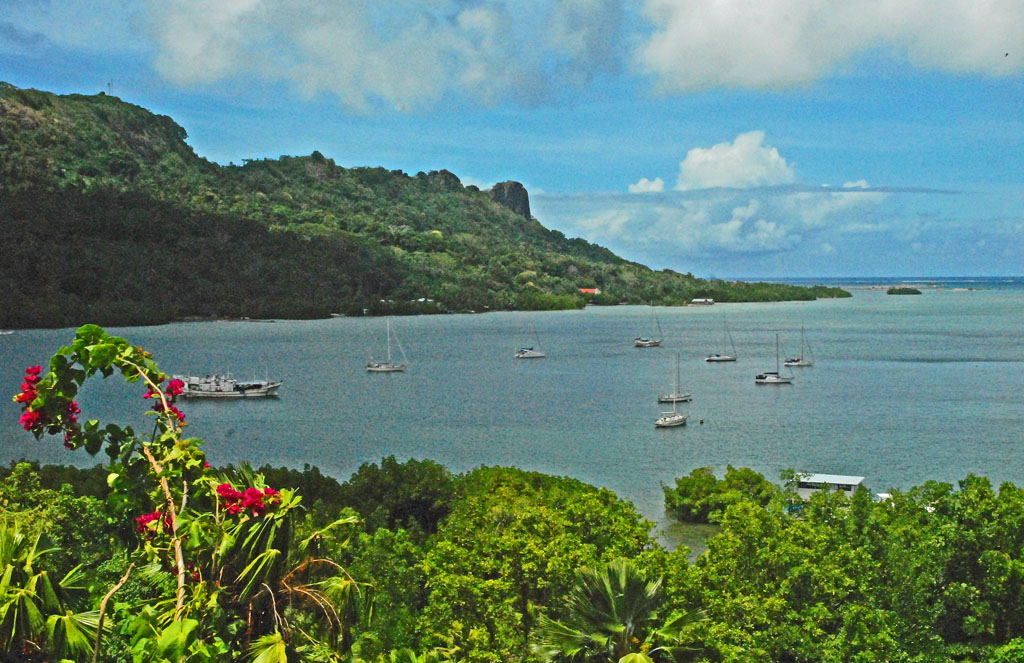
What we’ve seen of Pohnpei so far is absolutely lovely. The people are exceedingly friendly and gracious (except that one). The town is much cleaner than most Pacific islands, and the lush jungle vegetation and abundant tropical flowers produce an exceptionally pleasant odor. It’s so funny how one’s cup can be so half full and another’s so half empty at the same spot. The SSCA Port Guide says “Pohnpei has nothing to offer, so don’t stop unless it’s an emergency”. We couldn’t disagree more. We just had one quick spin around town yesterday and are fussing around on the boat today. Rob’s gone back into town now to pick up our cruising permit while I catch up on internet chores. Tomorrow we plan to go on a hike around the island you see on the left side of the picture of the harbor. It’s about 6 level miles around, which should be a nice hike.

Today on Yohelah we’re enjoying the beautiful Federated States of Micronesia…..

Teresa

Pohnpei is here.

20 - Pohnpei

How Many Ways Can You Chafe A Halyard?

When we arrived at Majuro in November we noticed that our main halyard had two major chafe spots in it – one where it came out of the mast at the top and one where it came out of the mast at the bottom. Not a happy sight at all. Luckily both spots were only chafed through the cover, and the line we used for our halyards is a very high tech line whose strength is primarily in the core. So I swapped out the halyard we use for the mainsail, which is on the port side, for the halyard we use for the storm trysail, which is on the starboard side. The two aren’t interchangeable as is because we have no winch on the starboard side to hoist and tension the halyard with. When we hoist the trysail (our small storm sail that goes up the mast in a separate track) we tension it with a multiple part block and tackle on the bottom.

We’ve had problems in the past with chafe on the halyard and have learned that if we keep the line very tight it doesn’t chafe. On the passage through the ITCZ into Majuro we had significant squalls packing 40+ knots of wind for hours at a time, putting pressure on the sail and halyard. We thought that’s why it had chafed. Unfortunately when we got to Pohnpei we found chafe again on the other main halyard after carefully watching the tension and experiencing only one brief squall the first night out. Well rats.

Masthead

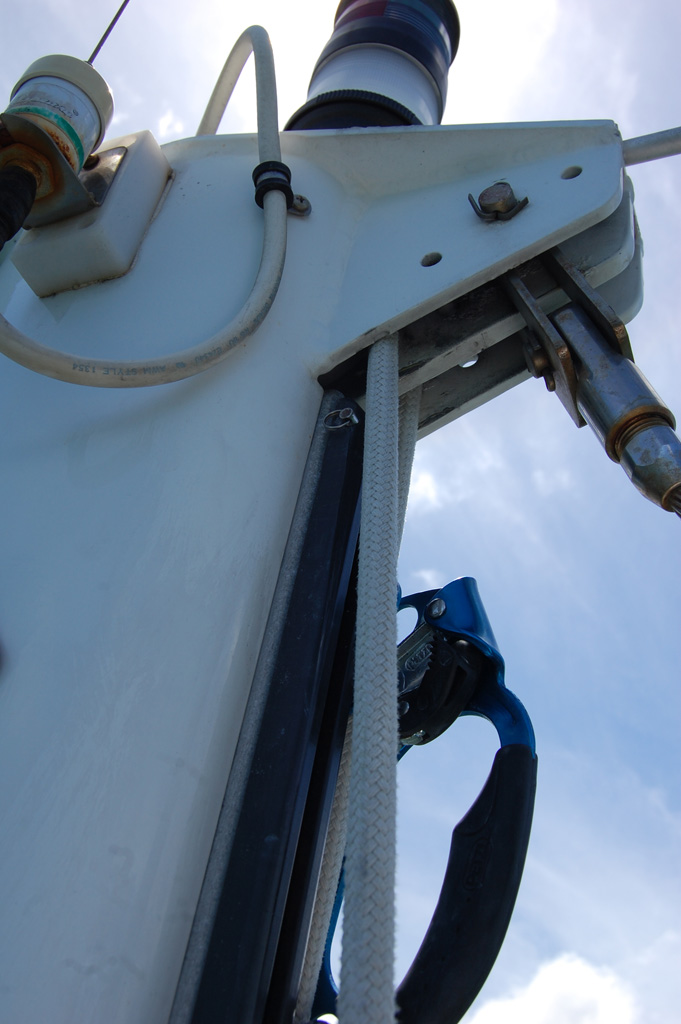
So Rob went aloft today to inspect the sheaves at the masthead, thinking there must be some problem with the hardware. What he found was a complete surprise and is going to be very hard to explain. What we have is an insert in the track where our mainsail hoists called Strongtrack. It’s made of UHMW plastic, and gives a nice frictionless surface for the sail slugs to hoist and drop. When it’s time for our mainsail to come down it literally just falls nearly as fast as gravity will take it. What had happened over the years is that the Strongtrack had worn down on the port side far enough to expose the pin at the top, which was now rubbing on the halyard when we sail on starboard tack. Who’d have guessed that would happen?

He pulled the pin out, believing it’s there to act as a stop for the mainsail slug, preventing it from coming out the top of the track. Having measured the distance to the top, he believes our sail can’t physically hoist that far. Besides which, I think we’ve hoisted without a reef only one day in the last year or two. We are emailing our sailmaker who recommended the Strongtrack to make sure that’s the only job the pin is doing and that we can just leave it out. If not, we’re going to have to pull the sail and the boom off, drop the Strongtrack down some and cut it off at the bottom. That may be a worse answer, though, because then we won’t get a full hoist on the sail.

The second chafe point where the halyard came out the bottom of the mast is even more interesting. When we were in the Galapagos we found a tiny little stainless pin with a weld spot at each end laying on the deck. We searched and searched (as did Brit from Hello World) to find where it came out of. Believing that it was nothing important enough to cause our mast to fall down, we hung on to it and waited to see what we figured out. Rob went sailing one day in Majuro while I was home and when he got done there was another of those pins on the deck. Putting the pieces together (halyard chafed at mast exit and unattached pins), he realized that the little pins that were on the deck had previously been welded to the inside of the plates for the mast exits. Where the halyards come out of the mast at the bottom, a hole is cut and a plate is riveted in. The pin at the top of the inside of the plate keeps the halyard from rubbing against the sharp edge of the plate. He drilled the rivets out of the two plates, took them and the pins to a stainless welder in Majuro and re-riveted them back on the mast.

So there you go. Two ways we never dreamed that you could chafe a halyard. And just for the record, halyards are not optional equipment on a sailboat. For people who have been cruising forever these things probably don’t seem that strange, but to me I just find it fascinating how many ways things can chafe.

Today on Yohelah we’re happy the two recent mysteries of halyard chafe are solved and wondering what the next will be…..

Teresa

20 - Pohnpei