Weather, luck , and the good side of the storm
The weather…
Between sailing the west coast of the America’s, long passages in the South Pacific, and crossing the equator four times we have experienced a lot of different weather and sailing conditions. Sailing across the Pacific has been challenging at times but very educational. We are truly different sailors than when we started out four years ago.
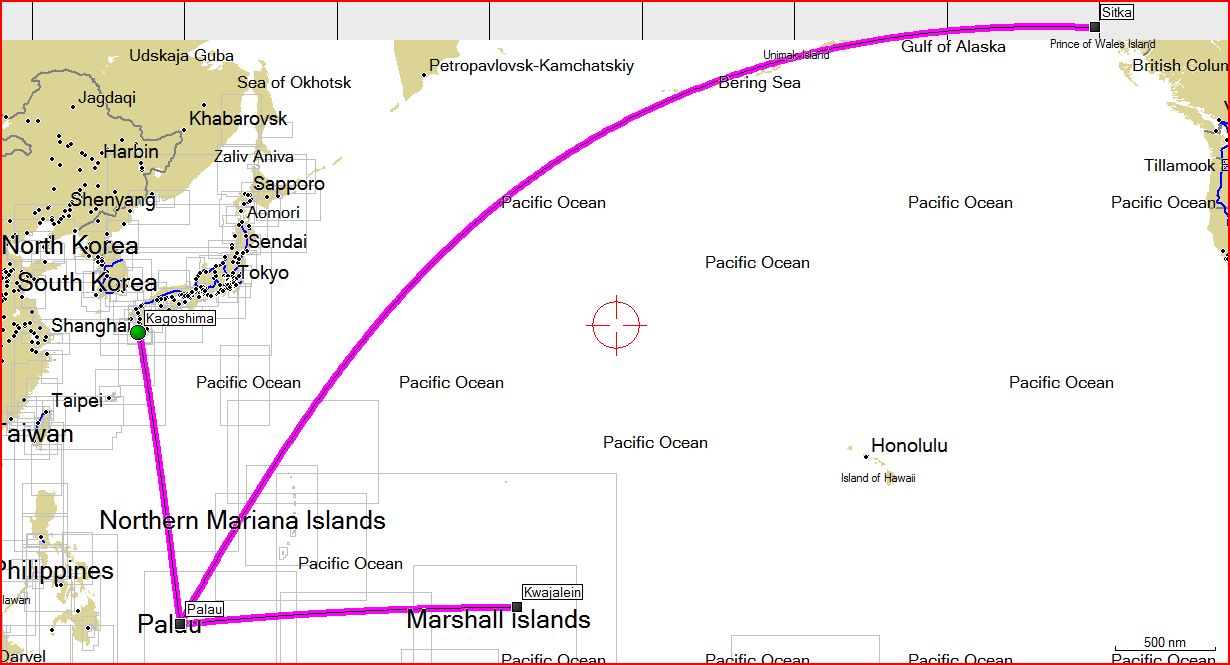
We have always avoided storms, ensuring we are safely ensconced in the northern hemisphere during hurricane season in the southern hemisphere, and vice versa. When we left Majuro to head across Micronesia, we entered an area of active hurricane formation for the first time cruising. Why? There is no off-season here. Well, technically there is, the off season is the same as for the rest of the North Pacific, which we are currently in. However, this area of Micronesia still spawns cyclones in the off season. A little over a week ago a cyclonic disturbance formed between Pohnpei and Chuuk, 1000 miles to the east of us. At the time we arrived in Yap the weather professionals were ‘watching’ the disturbance to see if it was likely to gain strength and move off towards us or dissipate toward the equator. They have several ‘models’ they use to predict future behavior, one was showing it developing into a storm system and heading north west towards us. This was the situation when we arrived in Yap. Four days later it HAD developed into a tropical depression and was moving west. By the end of our first weekend on Yap we were sure it was coming our way, the only question was it’s exact path.
The winds in tropical storms and cyclones in the northern hemisphere rotate counter-clockwise and the whole storm system travels between 10 and 20 knots. Since the winds rotate counterclockwise, the storm winds on the right side are enhanced by the 10-20 knots of storm movement. If the storm is moving at 15 knots, then the winds on the right side are 15 knots faster. The opposite is true on the left side of the storm. These winds are blowing into the winds caused by the storm movement and so have the 15 knot storm speed subtracted from their speed. The end result is a 30 knot difference in wind speed based on which side of the storm hits you – you may remember this from when Katrina ran over New Orleans they were hit by the fiercer, right side of the hurricane.
With the storm a couple of hundred mile away NOAA was predicting a path for our tropical depression that went south of Yap, putting us on the more dangerous side of the storm. It was officially a tropical storm at this point, with winds over 40 knots. It was moving at 15 knots, giving us a 30 knot difference in wind from one side to the next. We all had our fingers crossed that the storm would veer north and give us the good side. It slowed down and indeed started veering more northerly, eventually passing 50 miles to the north of Yap. We were spared the higher winds, the peak we saw was 38 knots with most of the wind in the 20-30 knot range. And so we weathered our first tropical storm.
Luck…
An Australian catamaran left Yap the day we arrived. We hadn’t met them but were sad to see them leaving because they had spent a lot of time in our next stop, Palau, and were a wealth of information. Fortunately they briefed mutual friends in the anchorage and so we have benefited from their knowledge. Before they left Yap one of the other sailboats asked them about the cyclonic disturbance around Chuuk, they thought an atoll would be better than being in Yap.
When the storm veered north and spared us it’s stronger side it just about ran over Ulithi atoll, where the Australians were set to weather the storm. Our good luck was their bad luck as they were hit with the strongest winds and seas from the tropical storm. They reported massive waves coming over the boat and lost two anchors. The boat ended up drifting across the atoll and ran aground on the reef, virtually destroying the boat. The good news is the couple and their two young daughters survived, bad news is the state of the boat. At last report it was still in the surf zone on top of the reef with the hull breached. They are attempting to get the boat off the reef and have committed the next six months to rebuilding the boat.
Risk management…
Sailing a boat around the Pacific is an exercise in risk management. I was just reading the January edition of Latitude 38, the San Francisco sailing magazine, marvelling at the letters criticizing the decisions of a boat in the South Pacific that was caught in a hurricane and destroyed in Fiji. I love armchair sailors and Monday morning quarterbacks, just not combined in the same person. It strikes me as arrogant to question someone else’s decisions when you are not in the same part of the world and do not have the burden of decision making in the same conditions as the boat. Seems to me the only critic should be someone else on the same boat, and not in a magazine.
Everyone out here does the best they can with what’s on hand. With mediocre holding in a small harbor surrounded by reefs there may have been a few more problems in Yap if the storm hadn’t veered. We’ll never know, but it did make me wish for a couple of more anchors and another hundred feet of chain. We already carry three anchors, 400 feet of chain, and 600 feet of rope rode, but traveling in an area of active tropical disturbances is a bit different than the off-season traveling we’ve done up ’til now. We’ll add more anchors.
Our boat is much heavier than a catamaran and carries much heavier anchoring gear. We also have less windage, less surface area exposed to the wind. All this means we are much less likely to drag in storm conditions. Our heavier boat also weathers large seas and high winds better than light catamarans, making the option of weathering a storm at sea much more attractive. So what would we have done? I don’t know, and won’t know until we are in those conditions. And our decision will be based on the strengths of our boat, so the correct decision for two boat in the same place at the same time can still be different, and still correct for both boats.
No Monday morning quarterbacks need apply.
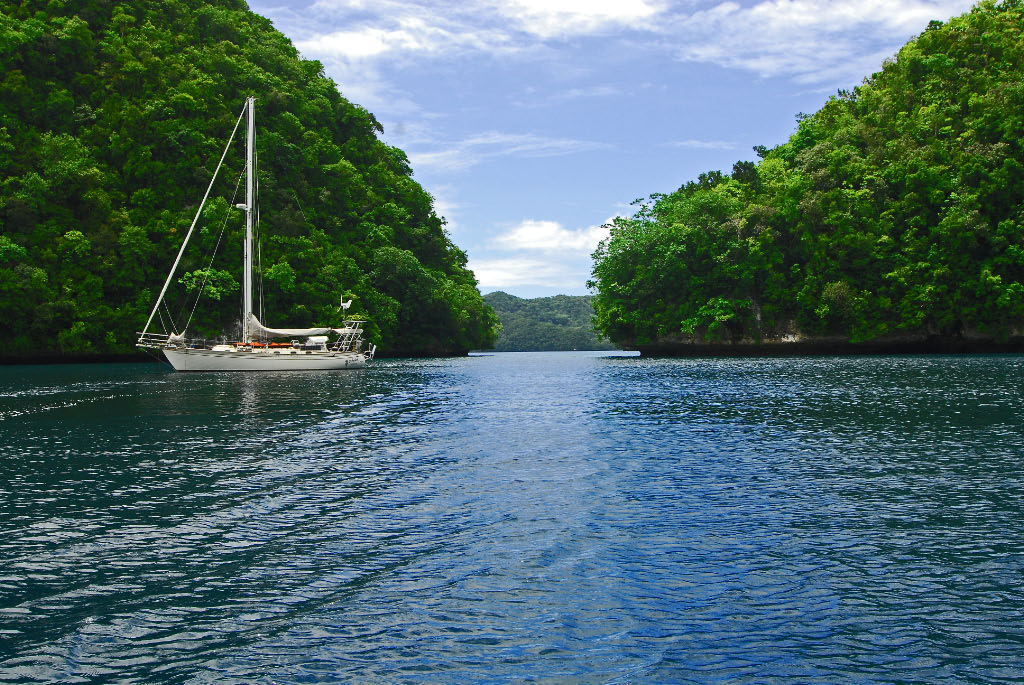
Today on Yohelah we are surrounded by land in Palau…
Rob

We came in with three other boats from Yap and decided to rent a couple of cars right after we arrived to do an island tour. The car rental company only had one large van, which conveniently sat 7 people – our exact number. So there we were, with Rob driving, Dave navigating, and myself, Linda and Lulu giving directions (all at the same time, usually to different places). It was hysterical. We were all amazed when we managed to accomplish our first stop, but ended up with a marvelous day touring nearly all the sights we set out to see. Rob has posted some nice pictures in the photo gallery of that tour.
Today we’re anchored in a little island group call Mecherchar, where fans of Survivor will remember the reward trip to Jellyfish Lake. It’s a lake where the jellyfish have evolved to a state of exceptionally mild stingers. They eat algae from the water, then float in the sun while the algae photosynthesizes and nourishes them. I have absolutely zero interest in swimming with a few thousand jellyfish, stingers or not, but Rob joined our friends Linda & Dave from Irish Melody for a swim yesterday and enjoyed it enough that he’s going back again this morning with the camera. Tomorrow we’ll head north to another island group where there are several Japanese shipwrecks to explore and some good snorkeling. Then we’ll go back to Koror to renew our permit (only 10 days at a time allowed for each permit) and come back to Blue Corner for more diving.