Goodbye Pohnpei, Hello Yap
We have a 9:00 appointment tomorrow morning with Mr. Personality from Immigration at the commercial dock to check us out of Pohnpei. Any guesses as to what time he shows up? I’m hoping by 11:00. The Port Captain’s office has prepared our Port Clearance document, which we have to pay $65 for. It’s surprising to me that we need a clearance, since technically we’re not leaving the country, but that’s their process. The weather forecast looks quite benign for our passage – I may even need to go haul the spinnaker out from under the bunk before we pack the forward cabin with stuff for the passage.
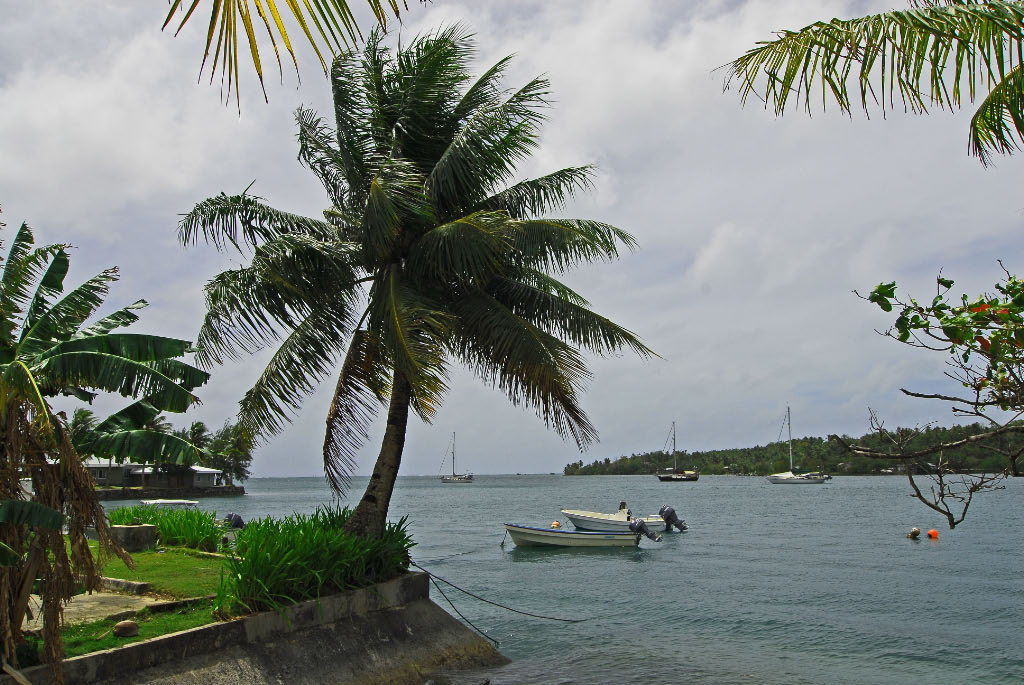
Our stop at Pohnpei has been absolutely enjoyable. The people couldn’t have been any friendlier. The sights are fairly typical Pacific Island, which translates to lovely. Living and housing conditions for the locals outside the city are “rustic”, but also typical. The homes seem to generally have some concrete floor and 3 or 4 walls made up of bamboo and/or corrugated tin, with a tin roof. People here seem quite happy and always have a wave and a smile for their visitors. Often times, however, the smiles are spoiled by the effects of Betel Nut. People here, as in many Pacific and Asian nations are often addicted to chewing Betel Nut, which is a custom dating back thousands of years. Regular betel chewing causes the teeth and gums to be stained an orange redish color, a look that was formerly considered attractive in certain cultures. Now, not so much.
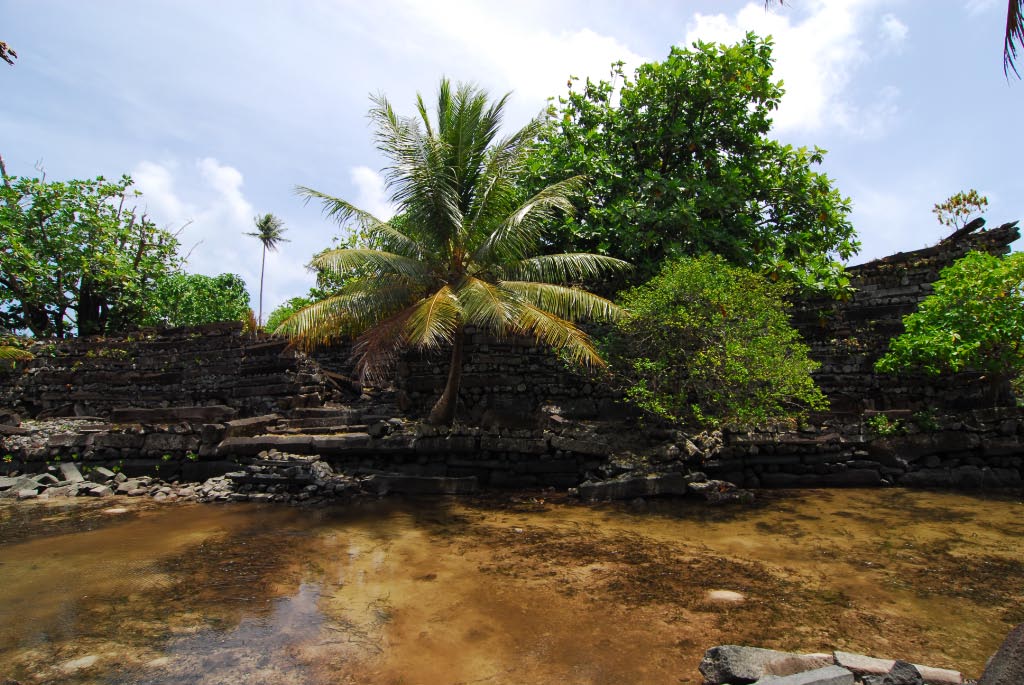
The excursion to Nan Madol was interesting. Making comparisons to places like Tikal or Machu Piccu is unfair, because archaeologists have spent years and fortunes unearthing and preserving those sites. Here, much of the compound appears to remain unearthed and the exposure to the sea has taken its toll. The quality of masonry and stonework pales in contrast to what the Incas built in Peru, but given what the locals had to work with, what they put together was pretty amazing. Rob will prepare some photos while en route to Yap and I’ll add them to our photo gallery.
The tour was short, taking about as long to view the site as it took to find it. On Wednesday when we were driving around the island we stopped to scope out Nan Madol and figure out where to go on Thursday when we visited. This is an island with few instructions for visitors. We finally found a sign, at an intersection near where we thought the site was, that stated we needed permission to visit and not to trespass. We drove down a dirt road, knowing from the guidebook that we needed to contact the Nahnmwarki of Madolenihmw, who was the chief of the area. There were a couple of houses along the road, but nothing that looked very chiefly. We drove to the end of the road, got out and walked around, and realized we were in the wrong spot. So we went back up to the intersection and took the other road, finding some dirt piles across the road. A local out in her yard explained to us that they were trying to improve the road and the piles should be gone by the next day. We’re not sure she understood when we tried to ask about the Nahnmwarki of Madolenihmw though.
Thursday morning we arrived back in the area early, hoping to tour around at low tide when we could walk between the islands. Again we searched for the chief’s house, stopping at one of the places along the first road. Apparently we got lucky because the woman who answered the door said she was the chief’s wife and was happy to take our $3 per person fee and grant permission for us to visit the site. She told Rob that if we came back at high tide they would take us for a tour in their pangas for $5 each. We opted for the low tide walking tour and headed back down the second road. The dirt piles were gone, so we proceeded in the direction we thought was to the ruins. We drove for a long time, and soon it became apparent the road was used infrequently. After a while we stopped at a house where a local was outdoors and he told Rob it was not in that direction.
After turning around we finally found a tiny little sign along the road that pointed down a turnoff. A woman was waiting at the corner for us and informed us that we need to pay her $1 each to access the site (we think it’s a fee to cross her land). We drove to the end of that dirt road and only found a house, so we went back to the woman at the corner (who, of course, was not longer on the corner since she had already collected her money). She said that yes, we were to park at the house and take the trail from there. By now we knew what that was going to entail, paying for access across their property. But in the end it was only $7 per person and at least the money went to the locals and not some tour company.
We kept the car for an extra day and got our laundry and shopping done, and the boat all topped up with diesel for the trip. Last night we hosted a potluck for the folks in the anchorage and said our goodbyes to the people from the small expat community living here on their boats.
Today on Yohelah we’re ready to put away the awning and dinghy and get the boat and cat back in “passage mode”….
Teresa

Today we’re boat bound as a tropical depression moves through the area for the next 36 hours or so. We’ve been watching it for a couple of days as it has built into a pretty good little system and heads directly between us and Palau. It has officially become the subject of a tropical cyclone formation alert from the joint typhoon warning center. But as it passes by us it “should” only be packing gusts of up to 35 knots in the squalls and thunderstorms. Normally we wouldn’t worry at all about that level of wind on anchor, but the mud from the mangroves surrounding the bay is very soft, and it took us 3 attempts to get our anchor to bite initially. Now that we’ve sat here for five days we’re feeling confident the anchor has penetrated through the soft mud on top down into a layer with more density and holding power below, but it’s a small harbor with little room to drag if we do start moving. So tonight we’ll be on anchor watch and hopefully get some naps between the squalls as the system passes by.
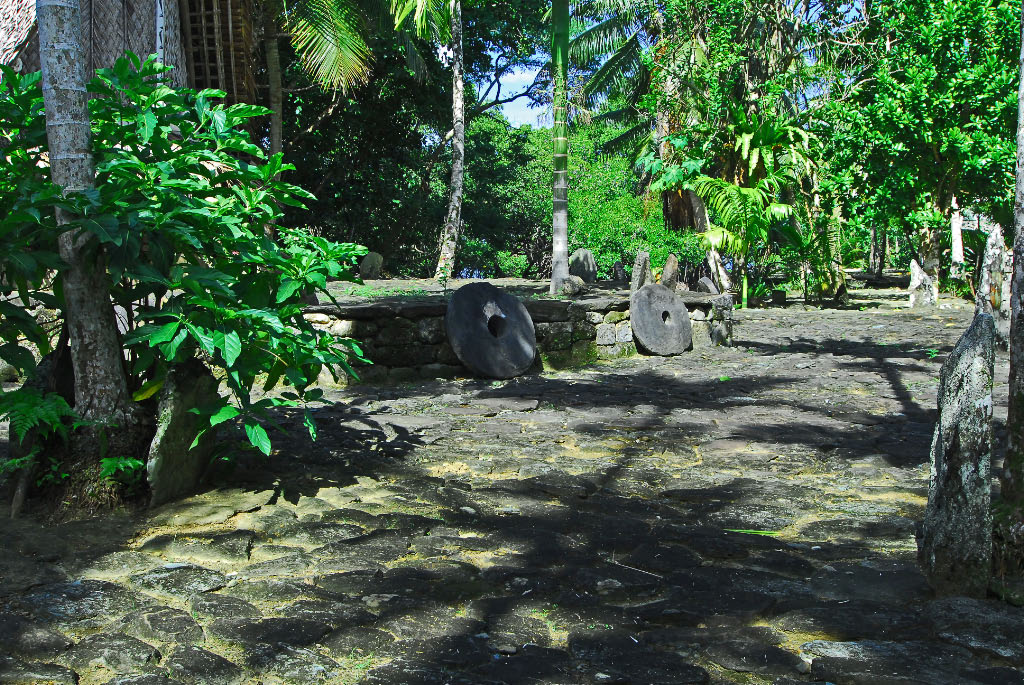
ter the storm passed by we did rent a car and toured the island. It’s a lovely place with lots of interesting sights. The Yapese are truly caretakers of their culture and work hard to manage a life of both traditional and modern values. One of the most interesting and certainly unique facets of their culture is the stone money. I don’t know when the tradition began, but they decided that stone from Palau, which in earlier times was very difficult to get, had value based on how difficult the journey was when it arrived. It was carved into circular shapes with a hole or two in the middle, allowing a stick to be inserted for carrying. But it really didn’t move much once it was on the island – it was grouped in “banks” near people’s homes or traditional community centers. While ownership of each piece of money might change, the locations did not. During the Japanese occupation they surveyed the stone money pieces and counted over 25,000. Even today the people of Yap consider the stones valuable. Hollywood produced their version of the story of Yap’s stone money, telling about an Irish seafarer who was shipwrecked in Yap in the late 1800′s and was ingenious enough to help get stone money delivered from Palau. We’re hoping to find a copy on Netflix when we get home.
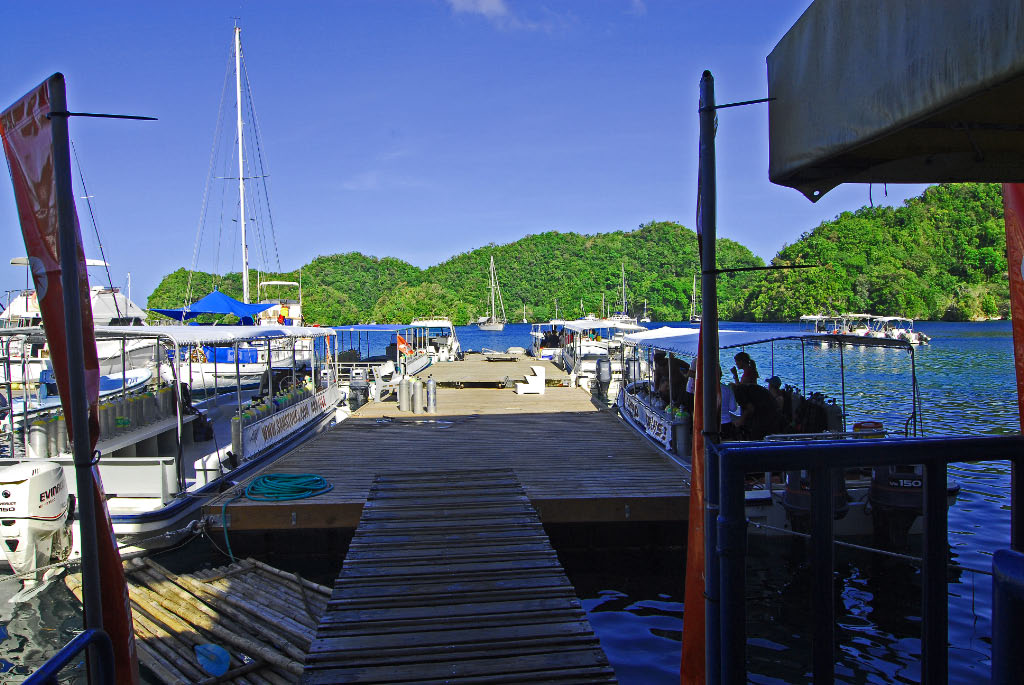
We’re tucked into a little bay where a very large dive organization also hosts the yachtie community. One of the other cruisers came by while we got lunch yesterday and gave us lots of info about Palau. One of the things I kept hearing from her was about this boat that came for 3 months and has been here for 12 years, or that other boat that came 4 years ago for two weeks and is still here. We are definitely pondering the notion of staying here and skipping Hong Kong. As much as we love a big city and were excited about eating dim sum until we fell over (ok, maybe that was me and not Rob), the 1,500 miles to get there from here just might not be worth it. Plus we’re still a little east of Japan, so the trip directly up from here shouldn’t be too bad, and we’ll avoid the nightly convection along the Chinese coastline.